Mining · first use case

How energy becomes Bitcoin

Mining is the process in which specialized machines compete to validate blocks of the Bitcoin network. They consume energy and deliver computing power — the hashrate. Here you understand each term, how BTC is produced and who pays for what. Always with variable output.

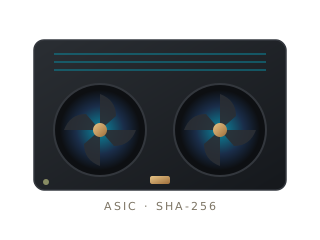
ASIC S19 Pro
Essential glossary

The terms, in plain language

ASIC

A machine built only for mining (e.g. Antminer S19 Pro). It serves no other purpose — it is optimized to compute SHA-256 hashes.

Hashrate

The machine's computing capacity. The more hashrate, the greater the technical participation in the attempt to validate blocks.

📊

TH/s

Terahashes per second — the unit of hashrate. An S19 Pro delivers about 110 TH/s.

Pool

A group of miners who pool their hashrate and share the results. It reduces the variance of mining alone.

🔧

Worker

Each machine (or identity) connected to the pool. It allows tracking individual output on the dashboard.

📉

Difficulty

The network self-adjusts: the more global hashrate, the harder it is to mine. This changes output roughly every 2 weeks.

Uptime

The time the machine is actually operating. Energy, maintenance and internet affect uptime — and output.

Halving

Roughly every ~4 years, the block reward is cut in half. It is the mechanism that makes BTC progressively scarce.

📈

Variable output

The result is never fixed: it depends on BTC price, difficulty, pool, uptime, energy and maintenance.

How the money is produced

From the outlet to the wallet

The BTC produced belongs to you and goes straight to the pool/wallet you designate — it never passes through the company's treasury.

Step 1

Energy enters the machine

The ASIC consumes electricity and converts it into computing power (hashrate).

Step 2

The machine works in the pool

The hashrate is sent to a pool (e.g. ViaBTC) that organizes participation in the network.

Step 3

The network rewards in BTC

When the pool validates blocks, it distributes the rewards according to the hashrate contributed.

Step 4

The BTC lands in your wallet

The payment goes straight to the address you configured in the pool. You verify it independently.

What you produce is yours

NW Energy is an infrastructure provider — not a manager of your BTC. Non-custodial: the asset is transferred, not retained.

You can receive in two ways: (A) directly through your ViaBTC account, or (B) via operational transfer from NW Energy to your wallet, with reports. In both, the BTC is yours from the moment of production.
Bitcoin payments are irreversible. Always check the wallet address before configuring.
Pool payment formats

Solo, PPLNS e PPS+

The pool defines how rewards are distributed. Each format trades risk for stability in a different way.

High variance

Solo

You (or the pool in solo mode) only receive when you find a whole block. A large, rare reward — maximum variance. Suited to those who understand the statistical risk.

  • ↑ Full reward when a block is found
  • ↓ Can go a long time with nothing
  • = More unpredictable result
Medium variance

PPLNS

Pay Per Last N Shares. You are paid for recent contributions when the pool finds blocks. It rewards consistency and tends to yield more in lucky pools, but fluctuates with the frequency of blocks.

  • ↑ Rewards continuous hashrate
  • ↓ Depends on the pool's luck in the period
  • = Moderate fluctuation
More stable

PPS+

Pay Per Share Plus. The pool pays for each share submitted at a fixed rate, plus a portion of the transaction fees. It is the most predictable format — the pool takes on the variance in your place.

  • ↑ Predictable payout per hashrate
  • ↑ Includes part of the network fees
  • = Lower variance for the client
No format guarantees returns. All depend on network difficulty, BTC price, pool fee and uptime. The choice is a matter of risk profile, not of guaranteed returns.risk × predictability, not of guaranteed returns.
Who pays and where to simulate

Payment and simulation via ViaBTC

Output and payments happen in the pool — ViaBTC, or the pool you designate. The pool is the one that pays the BTC, straight to your wallet. To estimate scenarios, use the official ViaBTC calculator.

Who pays the BTC
The pool (ViaBTC / designated by you)
Where to simulate scenarios
Official ViaBTC calculator
NW Energy's role
Infrastructure, energy and proof
What affects output

It does not depend on a single variable

BTC price
Network difficulty
%
Pool fee
Uptime
Energy
🔧
Maintenance
🌡
Temperatura
Halving
Mining output is variable and can change according to Bitcoin network difficulty, BTC price, pool fee, uptime, energy, maintenance and external conditions. No data represents a guarantee of returns.

Ready to see it in practice?

Start by understanding, simulate through ViaBTC and follow along through the proof.

This content is educational and does not recommend any strategy. Read the risks.