Energy, mining, Bitcoin, technical terms, proof and currency — explained in plain language. Our role is to educate, record and show; yours is to decide consciously.
Energy is the economic foundation of the operation. Without competitive, stable and well-managed energy, mining, AI and data centers lose efficiency. NW Energy's goal is to study, organize and monetize energy more efficiently — connecting generation, intensive consumption, machines, data and services. Energy is not just a cost: it is the raw material of digital infrastructure.
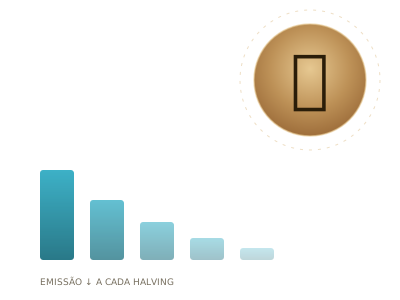
Energy page →Bitcoin has a maximum supply of 21 million units and an issuance that halves roughly every 4 years (the halving). Unlike currencies that can be printed, BTC becomes progressively harder to produce.
By mining, you convert energy (a recurring cost) into a limited-supply asset. It is a way to "store" energy today in something that tends toward scarcity — instead of keeping it exposed to currency inflation. This is potential, not a promise: the BTC price is volatile.
The machine (ASIC) consumes electricity and generates computing power.
The computation is sent to a pool (e.g. ViaBTC) that organizes participation in the network.
When validating blocks, the pool distributes BTC according to each participant's hashrate.
The payment goes straight to the address you designate. You verify it independently.
Computing power. TH/s = terahashes per second.
A group that pools hashrate and shares results.
Each machine/identity connected to the pool.
A network adjustment that changes output roughly every 2 weeks.
The machine's actual operating time.
Reward halved roughly every ~4 years.
No. Mining is the first real use case, but the focus is energy, better pricing and infrastructure: machine leasing, mini data centers and operational proof.
No. Mining has variable output depending on network difficulty, BTC price, pool, uptime, energy and maintenance. No simulation is a promise of returns.
It is the ecosystem's utility token — it organizes access to services, dashboard, proof and contracts. It is not a share, debt, investment or promise of profit.
The pool — ViaBTC or the pool you designate. The payment goes straight to your wallet. The BTC belongs to you from the moment of production and does not pass through the company's treasury.
On the official ViaBTC calculator, which uses current difficulty and price. On our site there is a plan simulator (NWM and capacity); the BTC estimate is handled by ViaBTC.
The expected methods include Pix, BTC, USDT, DePix and BNB/BSC, subject to availability and review. Crypto payments are a means of payment for the company's own services — the company does not do exchange, brokerage or custody.
It is the stage where we link contract, payment, access, proof and dashboard. For low-risk cases, activation can occur within 6 hours after confirmation and approval.
No. NW Energy is a provider of infrastructure, energy and proof. It does not operate exchange, brokerage, intermediation or custody of crypto assets.
Not the sensitive data. The blockchain records only hashes, CIDs, timestamps and technical references. CPF, documents and full contracts stay in a private environment.
It is the educational entry point: getting to know the dashboard, the proof and the operation before signing up. It is not a way to make money and does not represent any promise of output.